

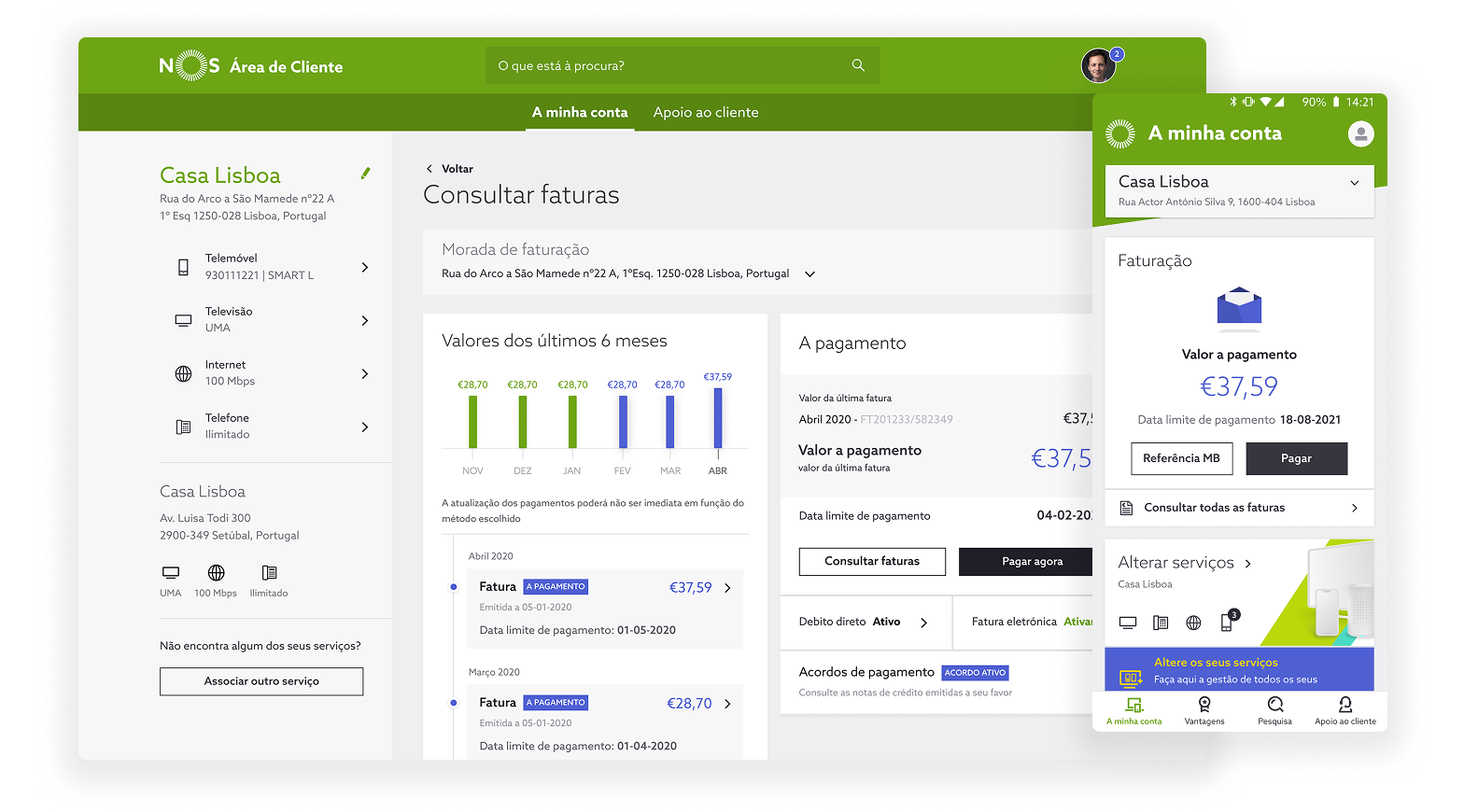
Redesigned home page
Building Infrastructure That Scaled Across 12 Designers
Design Systems
Design Ops
User Research
Consumer Apps
I joined NOS, Portugal's largest telecoms provider, as a UX/UI designer on self-service apps used by over a million customers, roughly 10% of the country. I left having built three things that weren't in my job description and outlived my tenure: the design system, the team's Figma workflow, and a research practice adopted across the team. All of it in parallel to shipping features.
The day job: making payments trustworthy
I was one of 12 designers, each on a different parts of the app, embedded in cross-functional squads and reporting to the Director of UX. I started on mobile payments and support, expanded to web, and eventually coordinated the app redesign.
Payments were always the hardest work. Customers don't trust telcos, least of all around invoicing, so every initiative carried an extra demand: make it understandable, easy, and transparent. The debt payment flow had to let people manage something genuinely stressful while reassuring them they weren't being misled, and let them move between levels of detail, from their overall plan down to individual negotiated invoices.
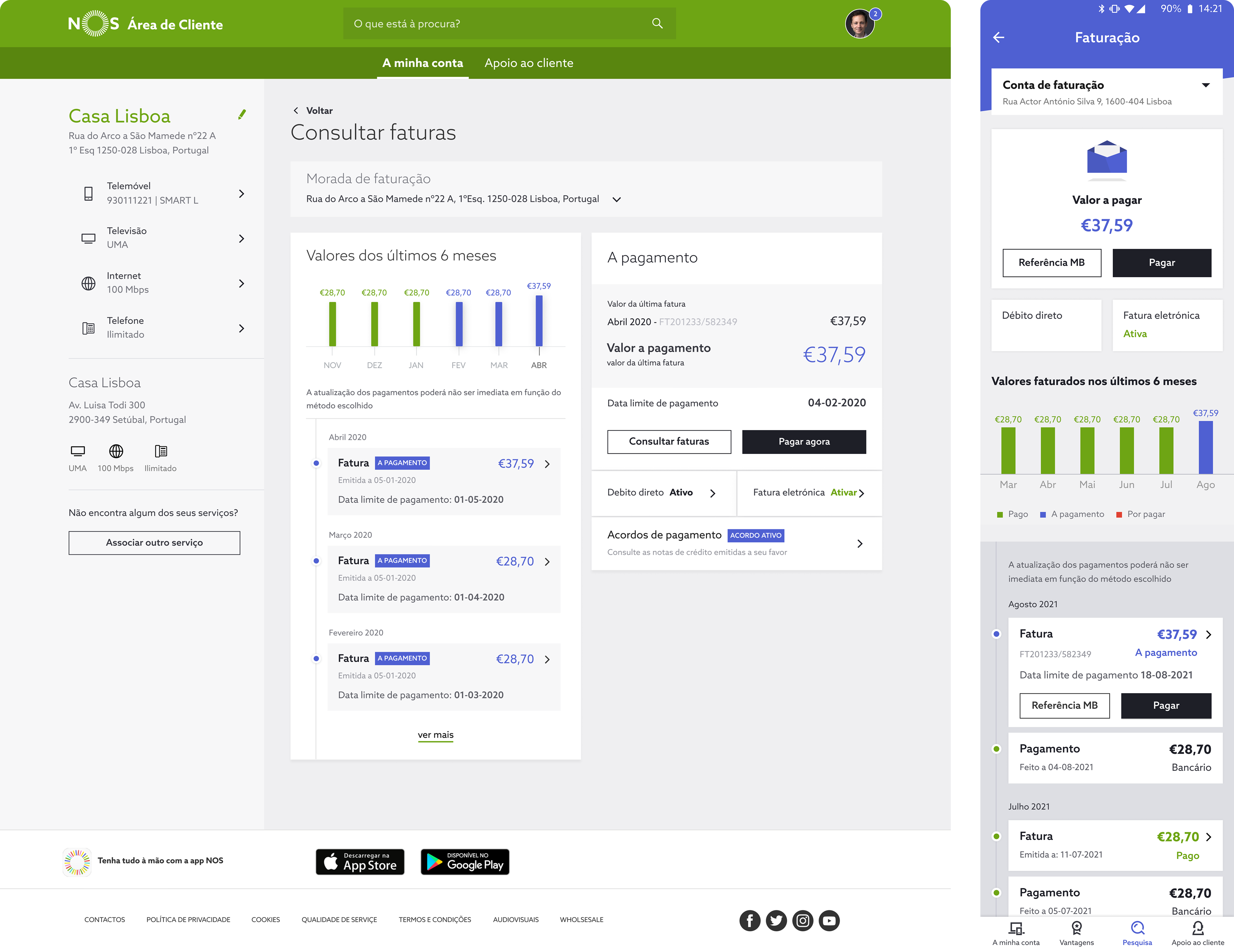
Invoicing history, Área de Cliente NOS web and mobile app
Support features posed a different problem: users had to perform technical actions, troubleshooting a router, diagnosing a connection, with no technical background. My job was to translate technical processes into flows anyone could follow.
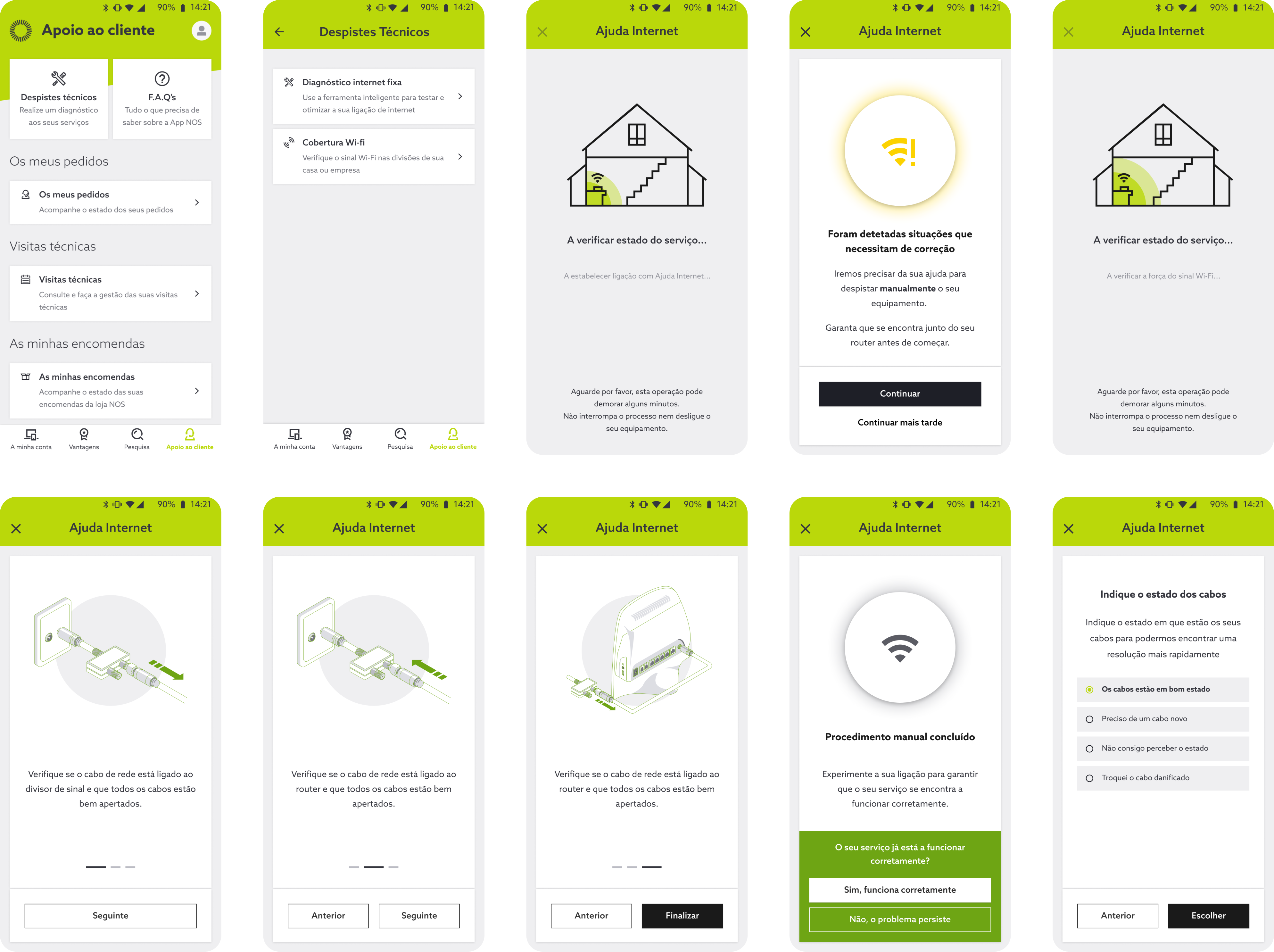
Router trouble shooting, Área de Cliente NOS mobile app
The multiplier work
Everything below happened alongside my feature work, and it's the part I'm proudest of, because it kept paying off after I left.
Design system
When I joined there was no design system or component library. I built both, for the mobile and web versions of the app. It stayed in use for years and was only deprecated in 2024, well after I'd gone.
Figma migration
I led the team's move from Sketch to Figma, which made collaboration between designers more efficient and gave product owners direct access to the work.
Research practice
I conducted more user interviews than any other designer on the team, both for my own initiatives and to support teammates. I created guidelines for writing interview scripts and conducting sessions, then ran workshops with four designers and two product owners to build their research skills.
Reflection
At NOS, I learned to look beyond my assignments. The design system, Figma migration, and research practices weren't in my job description, but they created leverage. One person building tools that twelve people use, that's how you multiply impact without adding headcount.
That systems-level thinking has defined every role since.


Redesigned home page
Building Infrastructure That Scaled Across 12 Designers
Design Systems
Design Ops
User Research
Consumer Apps
I joined NOS, Portugal's largest telecoms provider, as a UX/UI designer on self-service apps used by over a million customers, roughly 10% of the country. I left having built three things that weren't in my job description and outlived my tenure: the design system, the team's Figma workflow, and a research practice adopted across the team. All of it in parallel to shipping features.
The day job: making payments trustworthy
I was one of 12 designers, each on a different parts of the app, embedded in cross-functional squads and reporting to the Director of UX. I started on mobile payments and support, expanded to web, and eventually coordinated the app redesign.
Payments were always the hardest work. Customers don't trust telcos, least of all around invoicing, so every initiative carried an extra demand: make it understandable, easy, and transparent. The debt payment flow had to let people manage something genuinely stressful while reassuring them they weren't being misled, and let them move between levels of detail, from their overall plan down to individual negotiated invoices.
Invoicing history, Área de Cliente NOS web and mobile app
Support features posed a different problem: users had to perform technical actions, troubleshooting a router, diagnosing a connection, with no technical background. My job was to translate technical processes into flows anyone could follow.
Router trouble shooting, Área de Cliente NOS mobile app
The multiplier work
Everything below happened alongside my feature work, and it's the part I'm proudest of, because it kept paying off after I left.
Design system
When I joined there was no design system or component library. I built both, for the mobile and web versions of the app. It stayed in use for years and was only deprecated in 2024, well after I'd gone.
Figma migration
I led the team's move from Sketch to Figma, which made collaboration between designers more efficient and gave product owners direct access to the work.
Research practice
I conducted more user interviews than any other designer on the team, both for my own initiatives and to support teammates. I created guidelines for writing interview scripts and conducting sessions, then ran workshops with four designers and two product owners to build their research skills.
Reflection
At NOS, I learned to look beyond my assignments. The design system, Figma migration, and research practices weren't in my job description, but they created leverage. One person building tools that twelve people use, that's how you multiply impact without adding headcount.
That systems-level thinking has defined every role since.

Redesigned home page
Building Infrastructure That Scaled Across 12 Designers
Design Systems
Design Ops
User Research
Consumer Apps
I joined NOS, Portugal's largest telecoms provider, as a UX/UI designer on self-service apps used by over a million customers, roughly 10% of the country. I left having built three things that weren't in my job description and outlived my tenure: the design system, the team's Figma workflow, and a research practice adopted across the team. All of it in parallel to shipping features.
The day job: making payments trustworthy
I was one of 12 designers, each on a different parts of the app, embedded in cross-functional squads and reporting to the Director of UX. I started on mobile payments and support, expanded to web, and eventually coordinated the app redesign.
Payments were always the hardest work. Customers don't trust telcos, least of all around invoicing, so every initiative carried an extra demand: make it understandable, easy, and transparent. The debt payment flow had to let people manage something genuinely stressful while reassuring them they weren't being misled, and let them move between levels of detail, from their overall plan down to individual negotiated invoices.
Invoicing history, Área de Cliente NOS web and mobile app
Support features posed a different problem: users had to perform technical actions, troubleshooting a router, diagnosing a connection, with no technical background. My job was to translate technical processes into flows anyone could follow.
Router trouble shooting, Área de Cliente NOS mobile app
The multiplier work
Everything below happened alongside my feature work, and it's the part I'm proudest of, because it kept paying off after I left.
Design system
When I joined there was no design system or component library. I built both, for the mobile and web versions of the app. It stayed in use for years and was only deprecated in 2024, well after I'd gone.
Figma migration
I led the team's move from Sketch to Figma, which made collaboration between designers more efficient and gave product owners direct access to the work.
Research practice
I conducted more user interviews than any other designer on the team, both for my own initiatives and to support teammates. I created guidelines for writing interview scripts and conducting sessions, then ran workshops with four designers and two product owners to build their research skills.
Reflection
At NOS, I learned to look beyond my assignments. The design system, Figma migration, and research practices weren't in my job description, but they created leverage. One person building tools that twelve people use, that's how you multiply impact without adding headcount.
That systems-level thinking has defined every role since.